Code
library(tidyverse)
library(ggplot2)
library(tidymodels)
library(rsample)
library(themis)
library(tidytuesdayR)

library(scales)
library(lubridate)

library(anytime) 
library(tidyverse)
library(ggplot2)
library(tidymodels)
library(rsample)
library(themis)
library(tidytuesdayR)
library(scales)
library(lubridate)
library(anytime)  download data from https://chip-dataset.vercel.app/
raw_chips <- read_csv("data/chip_dataset.csv")chips <- raw_chips %>%
select(-1) %>%
janitor::clean_names() %>%
mutate(old_release_date=release_date
,process_size_nm=as.numeric(process_size_nm)
,release_date_pre = as.Date(release_date, format = "%m/%d/%Y")
,transistors_million=as.numeric(transistors_million)
,transistors = transistors_million * 1000000
,year = year(release_date_pre)+2000
,month=month(release_date_pre)
,day=day(release_date_pre)
,release_date=make_date(year,month,day)
) %>% filter(year<=2023)head(chips)# A tibble: 6 × 18
type release_date process_size_nm tdp_w die_size_mm_2 transistors_million
<chr> <date> <dbl> <chr> <chr> <dbl>
1 CPU 2000-06-05 180 54 120 37
2 CPU 2000-10-31 180 54 120 37
3 CPU 2000-08-14 180 60 120 37
4 CPU 2000-10-31 180 63 120 37
5 CPU 2000-10-31 180 66 120 37
6 CPU 2000-10-17 180 66 120 37
# ℹ 12 more variables: freq_g_hz <dbl>, foundry <chr>, vendor <chr>,
# fp16_gflops <dbl>, fp32_gflops <dbl>, fp64_gflops <dbl>,
# old_release_date <chr>, release_date_pre <date>, transistors <dbl>,
# year <dbl>, month <dbl>, day <int>dim(chips)[1] 4707 18chips %>%
count(type)# A tibble: 2 × 2
type n
<chr> <int>
1 CPU 2148
2 GPU 2559chips %>%
count(year = year(release_date),
type) %>%
ggplot(aes(year, n, fill = type)) +
geom_col() +
labs(x = "Year",
y = "# of chips")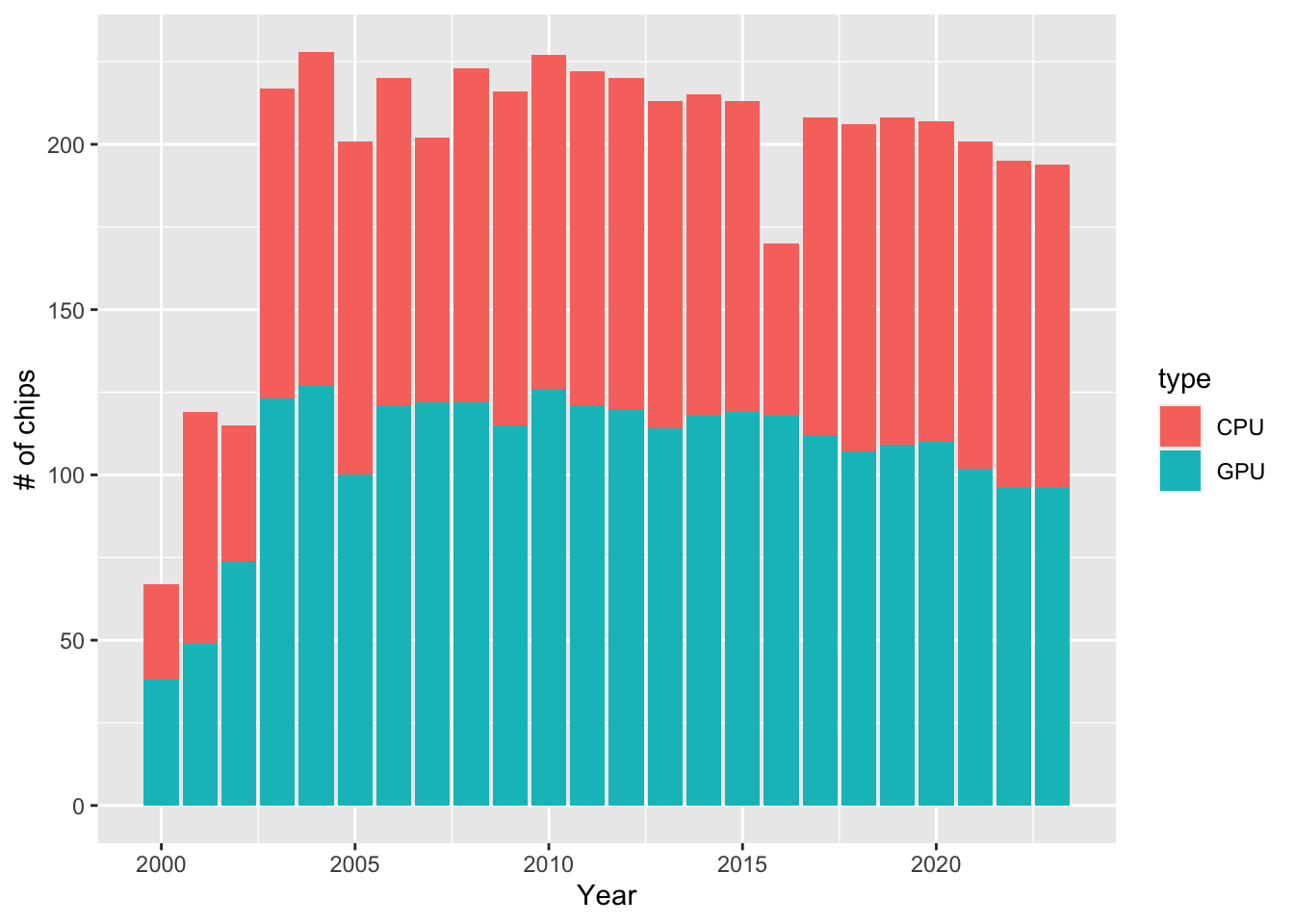
chips %>%
  ggplot(aes(transistors_million)) +
  geom_histogram() +
  scale_x_log10(labels = label_number(suffix = "M", big.mark = ","))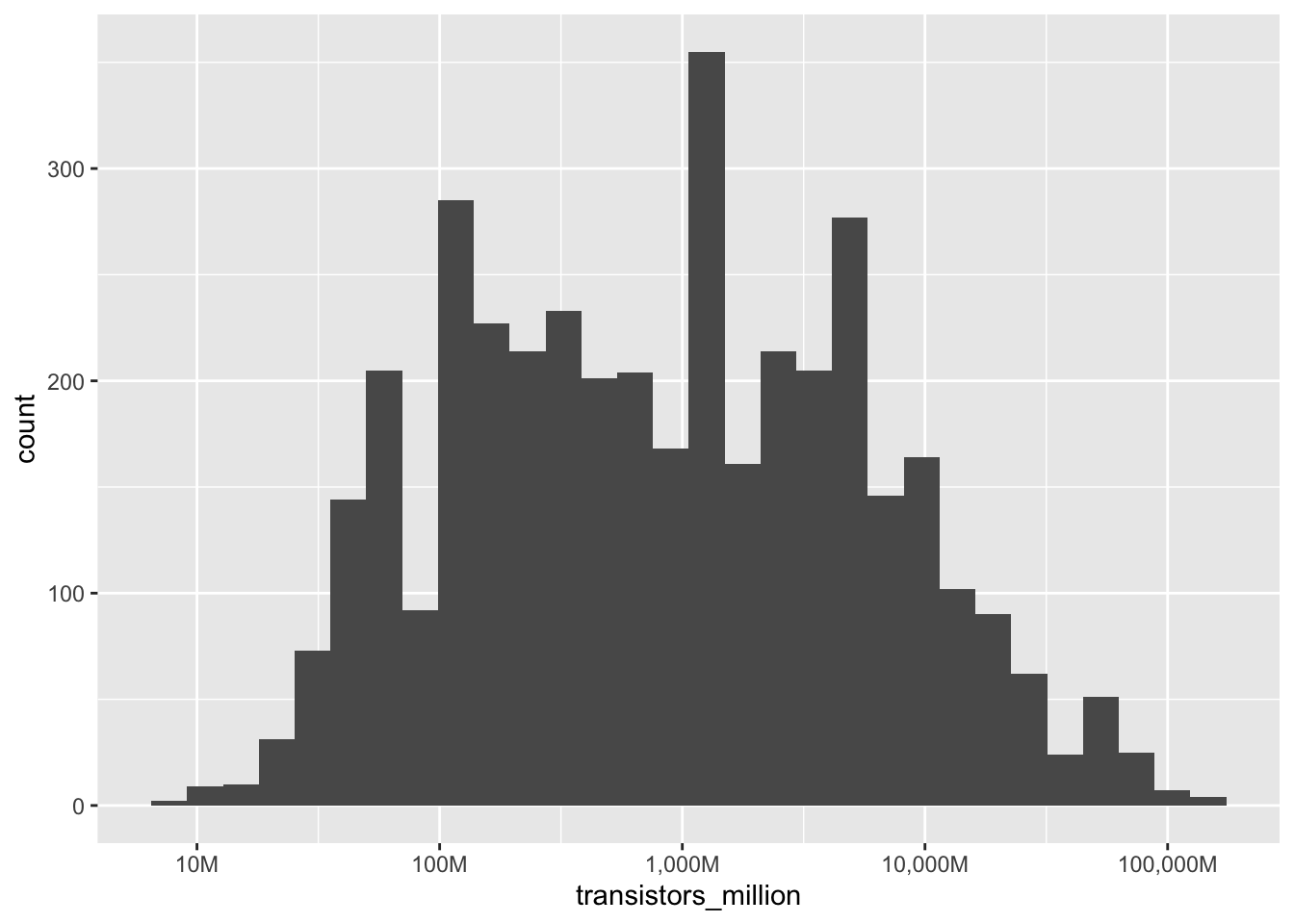
summarize_chips <- function(tbl) {
  tbl %>%
    summarize(pct_gpu = mean(type == "GPU"),
              median_transistors = median(transistors, na.rm = TRUE),
              geom_mean_transistors = exp(mean(log(transistors), na.rm = TRUE)),
              n = n(),
              .groups = "drop") %>%
    arrange(desc(n))
}chips %>%
group_by(year = year(release_date)) %>%
summarize_chips() %>%
ggplot(aes(year, median_transistors)) +
geom_line() 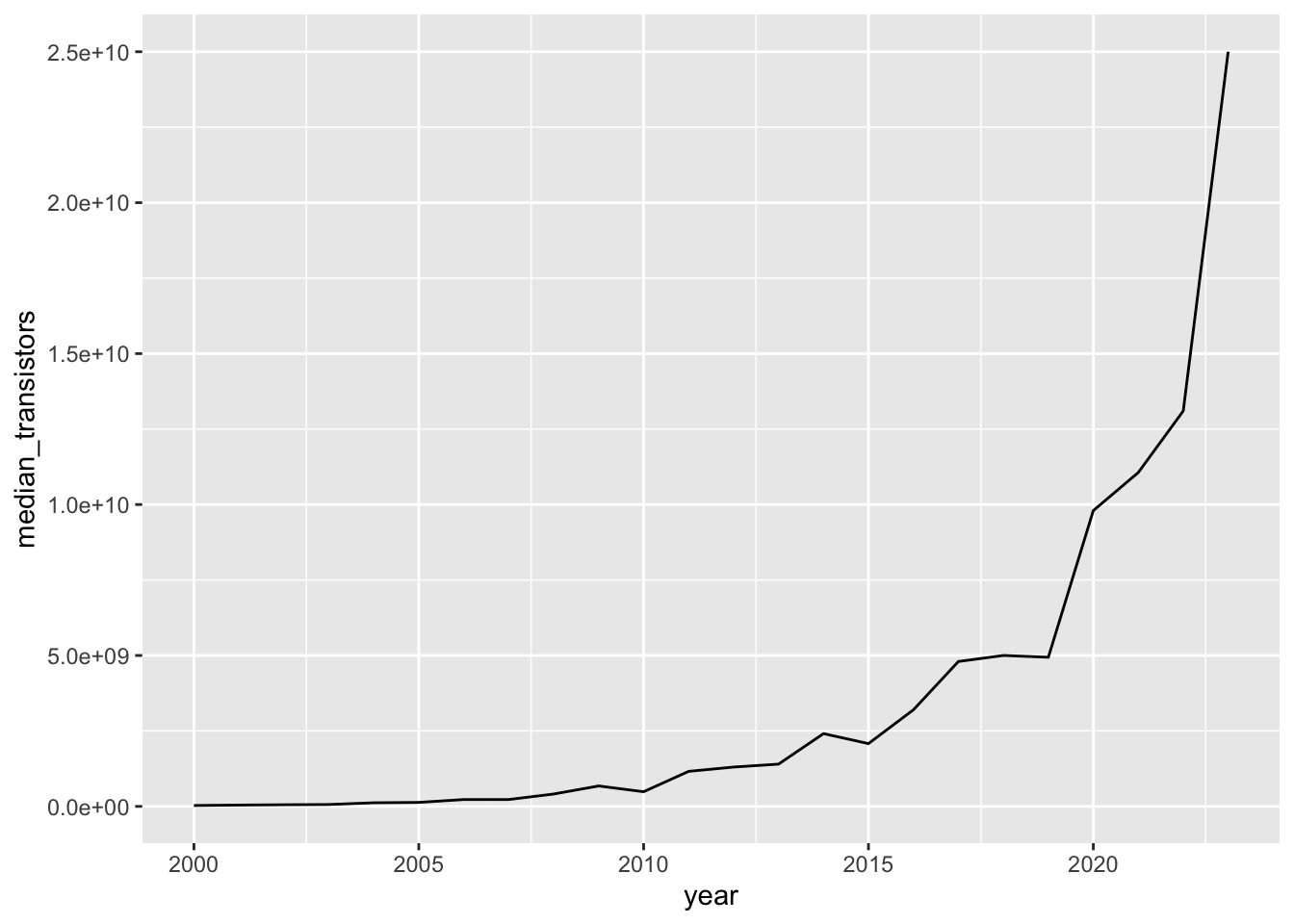
chips %>%
  mutate(years_since_2000 = as.integer(release_date - as.Date("2000-01-01")) / 365) %>%
  mutate(moores_law = 30 * 2 ^ (.5 * years_since_2000)) %>%
  ggplot(aes(release_date, transistors_million)) +
  geom_point() +
  geom_line(aes(y = moores_law), color = "red") +
  geom_smooth(method = "loess") +
  scale_y_log10() +
  labs(x = "Chip release date",
       y = "# of transistors (millions)",
       title = "We are a bit below Moore's Law")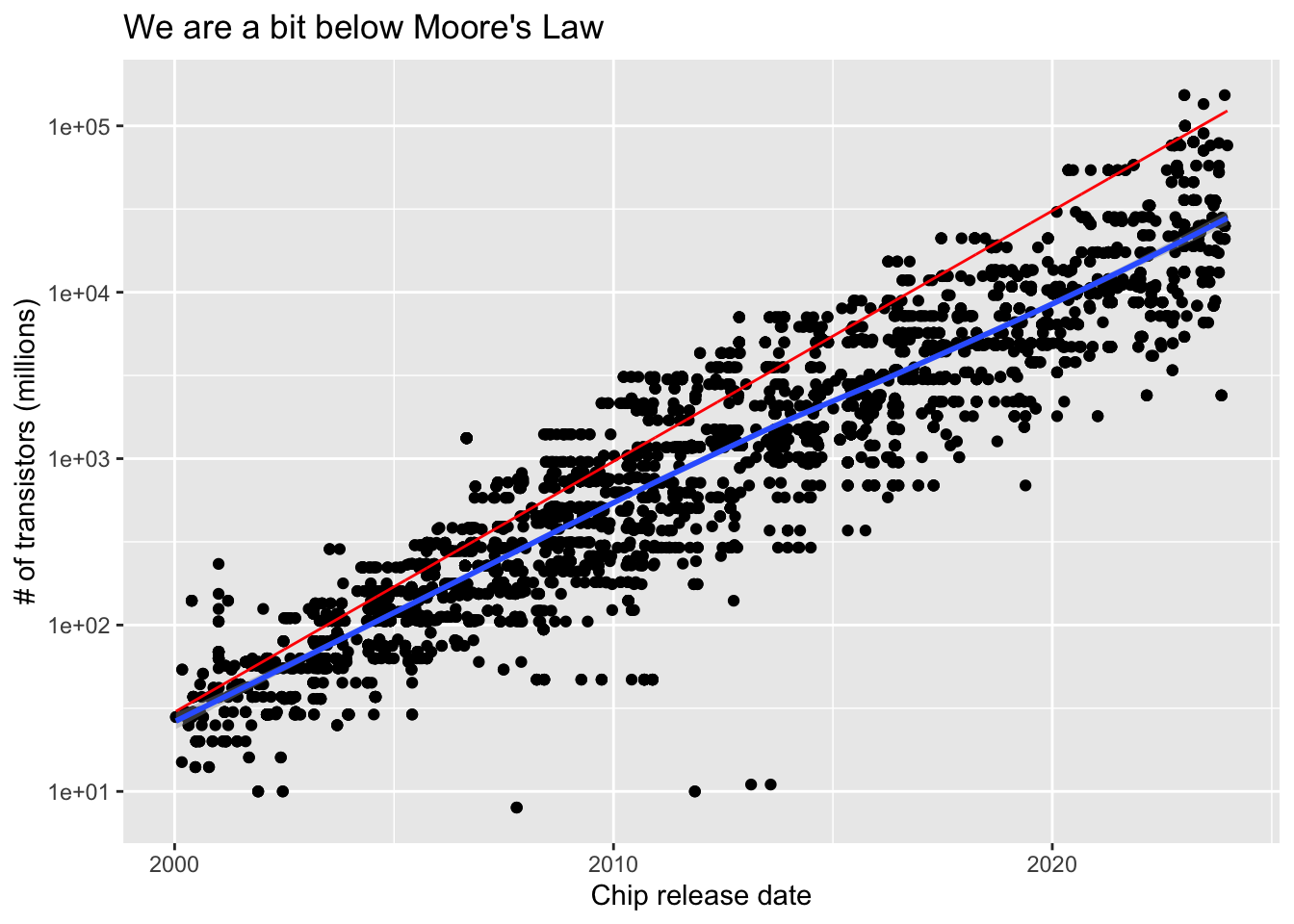
chips %>%
  group_by(foundry = fct_lump(foundry, 6),
           type) %>%
  summarize_chips() %>%
  mutate(foundry = fct_reorder(foundry, n, sum)) %>%
  ggplot(aes(n, foundry, fill = type)) +
  geom_col() +
  labs(y = "Chip creator")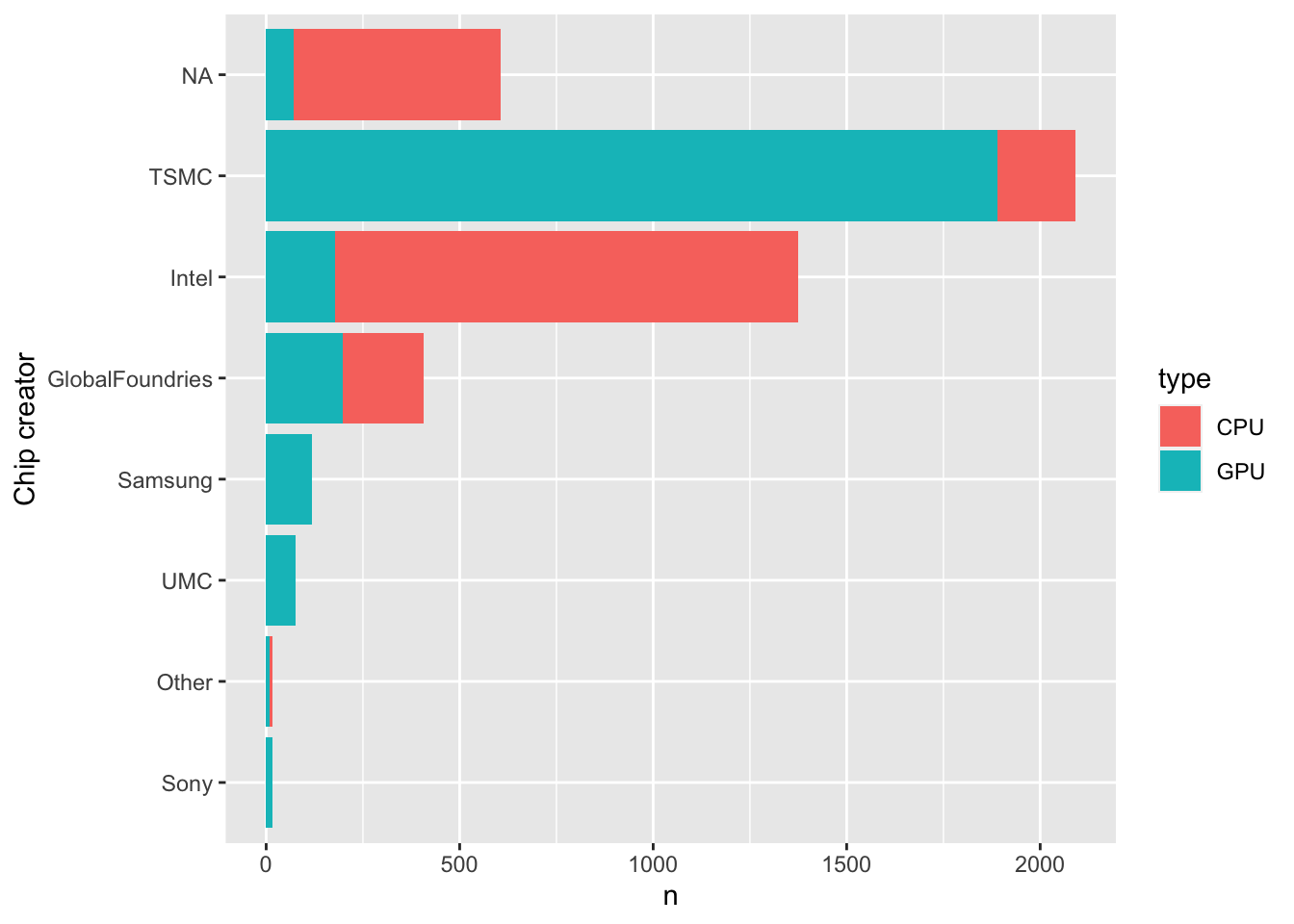
chips %>%
  group_by(foundry = fct_lump(foundry, 2),
           year) %>%
  summarize_chips() %>%
  ggplot(aes(year, median_transistors, color = foundry)) +
  geom_line() +
  scale_y_log10()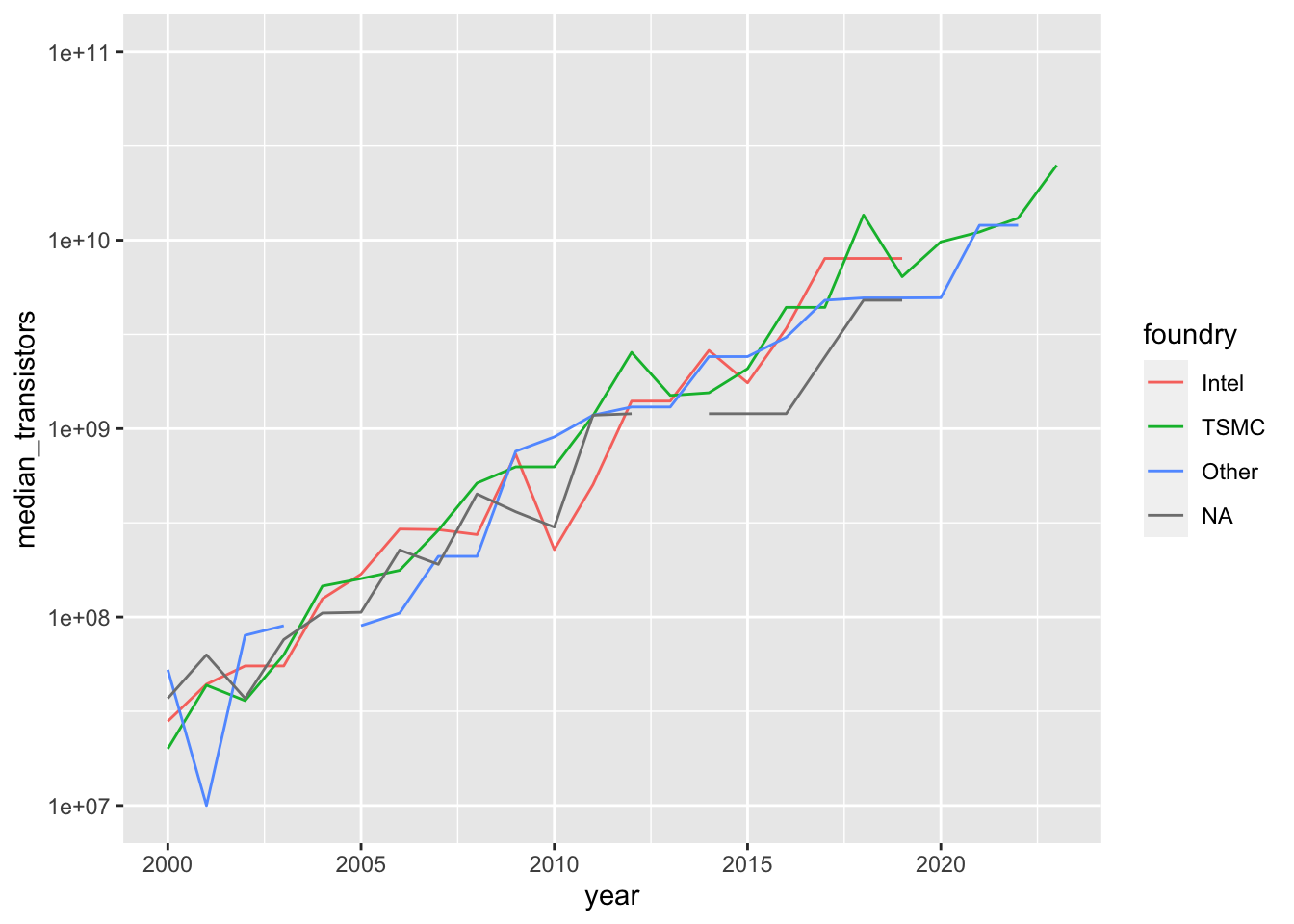
chips %>%
  mutate(foundry = fct_lump(foundry, 2)) %>%
  ggplot(aes(release_date, transistors_million,
             color = foundry)) +
  geom_point(alpha = .1) +
  geom_smooth(method = "lm") +
  scale_y_log10() +
  labs(x = "Chip release date",
       y = "# of transistors (millions)")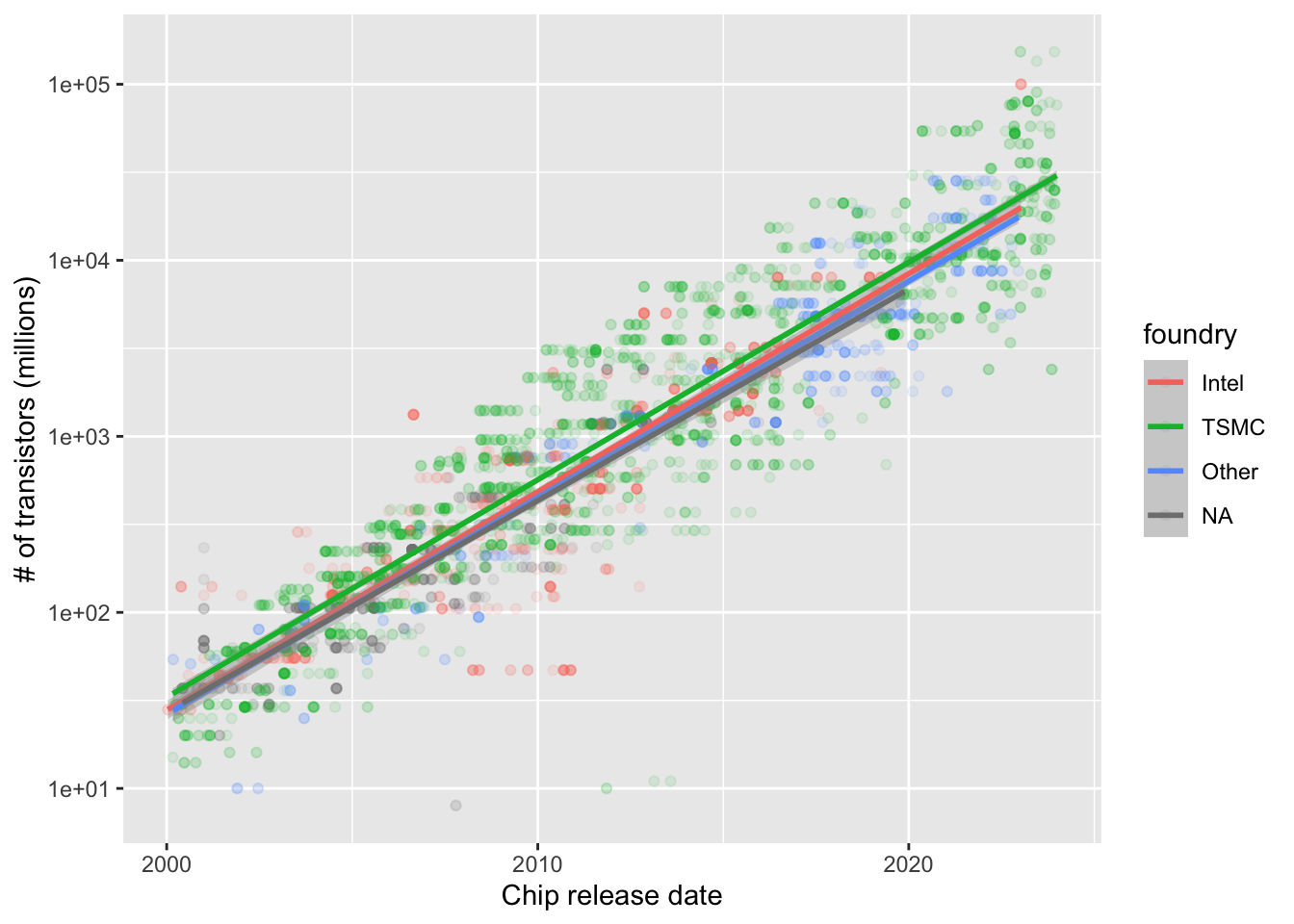
chips %>%
  ggplot(aes(fp64_gflops)) +
  geom_histogram() +
  scale_x_log10()
chips %>%
  filter(!is.na(fp32_gflops)) %>%
  ggplot(aes(release_date,
             fp32_gflops)) +
  geom_point() +
  geom_smooth(method = "lm") +
  scale_y_log10() +
  labs(x = "Chip release date",
       y = "Gigaflops (fp64)")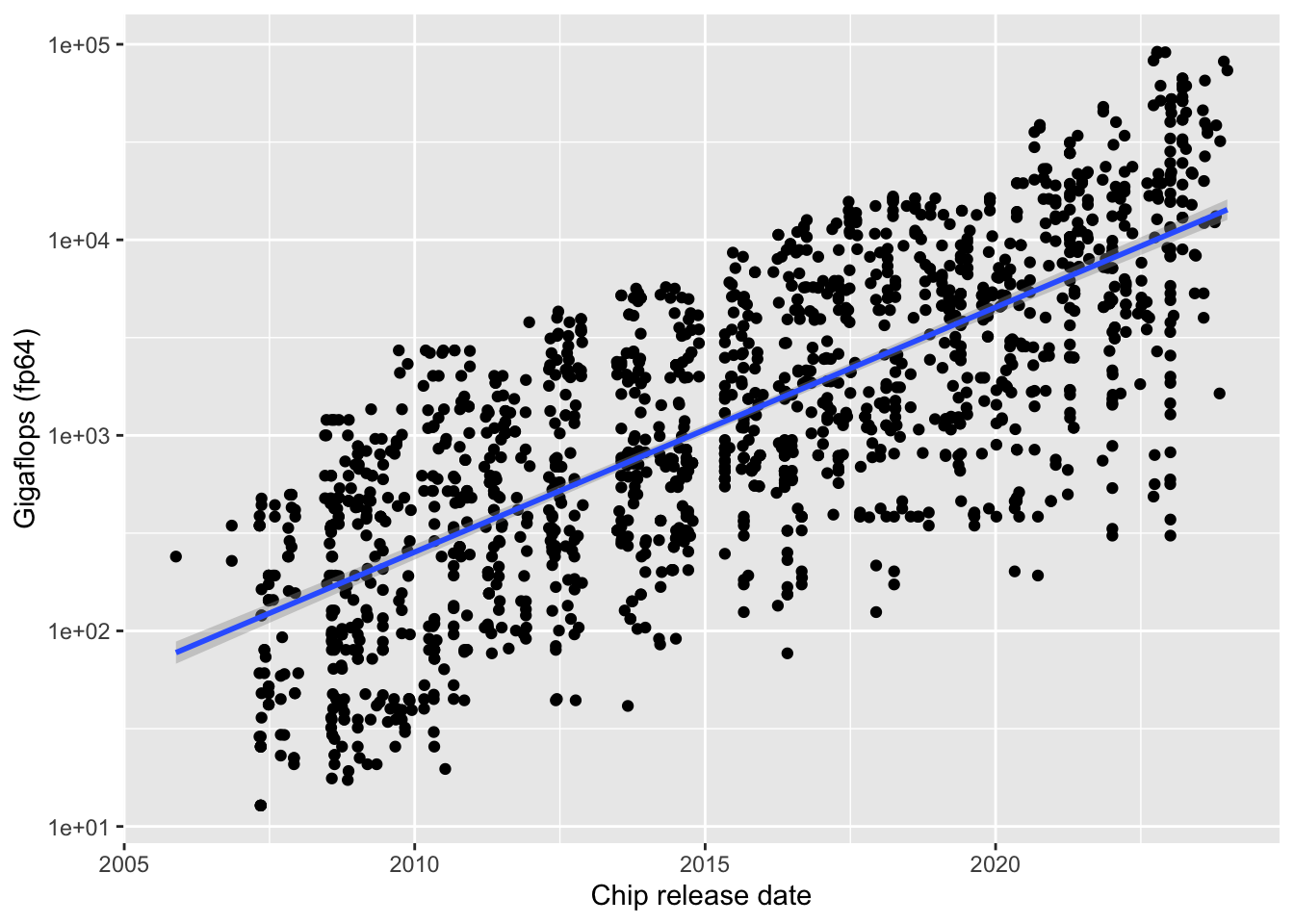
chips %>%
  filter(!is.na(fp32_gflops)) %>%
  group_by(year) %>%
  filter(n() >= 50) %>%
  ggplot(aes(transistors_million, fp32_gflops)) +
  geom_point() +
  facet_wrap(~ year, scales = "free") +
  scale_x_log10() +
  scale_y_log10()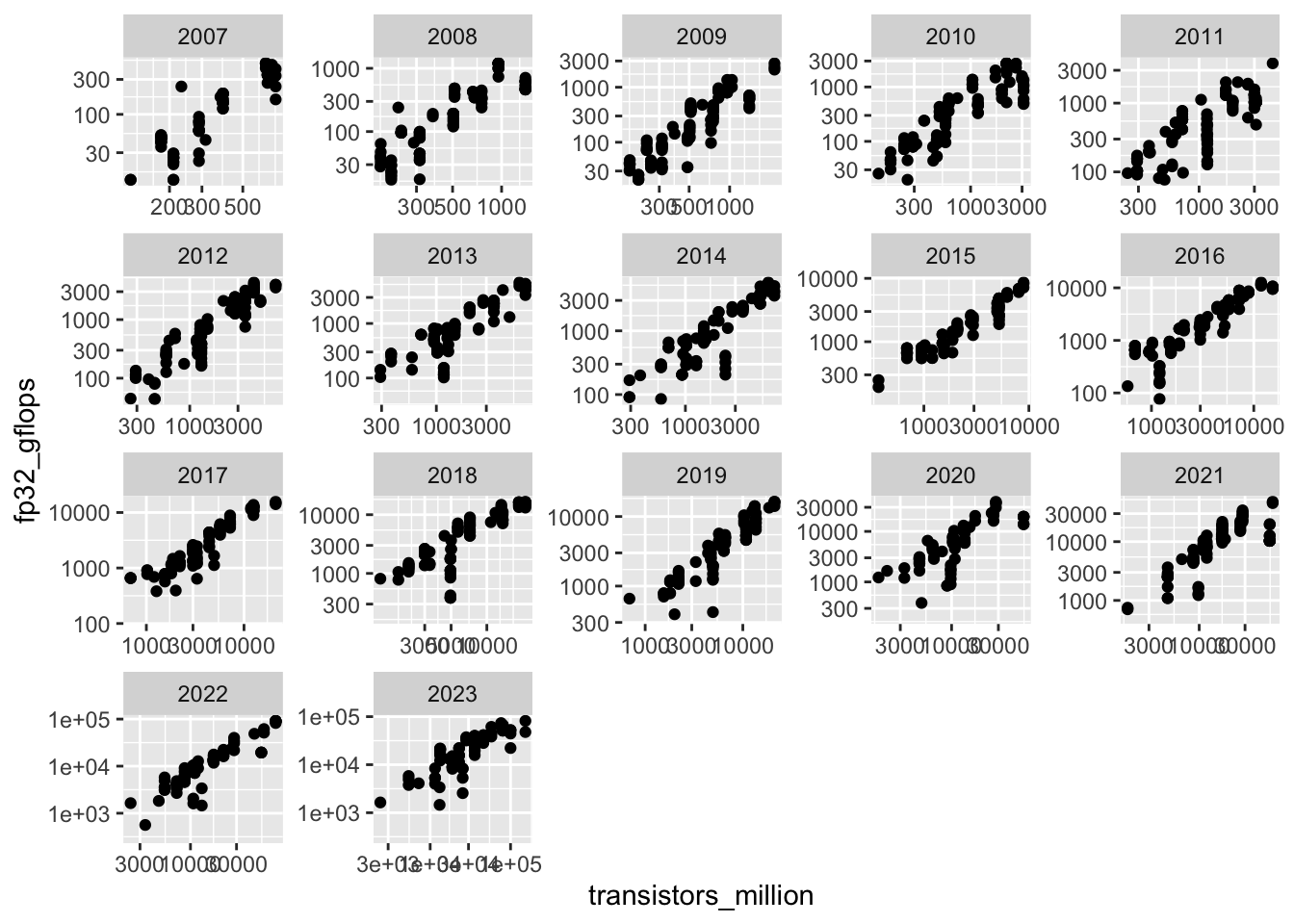
chips %>%
  ggplot(aes(release_date, process_size_nm)) +
  geom_point() +
  scale_y_log10()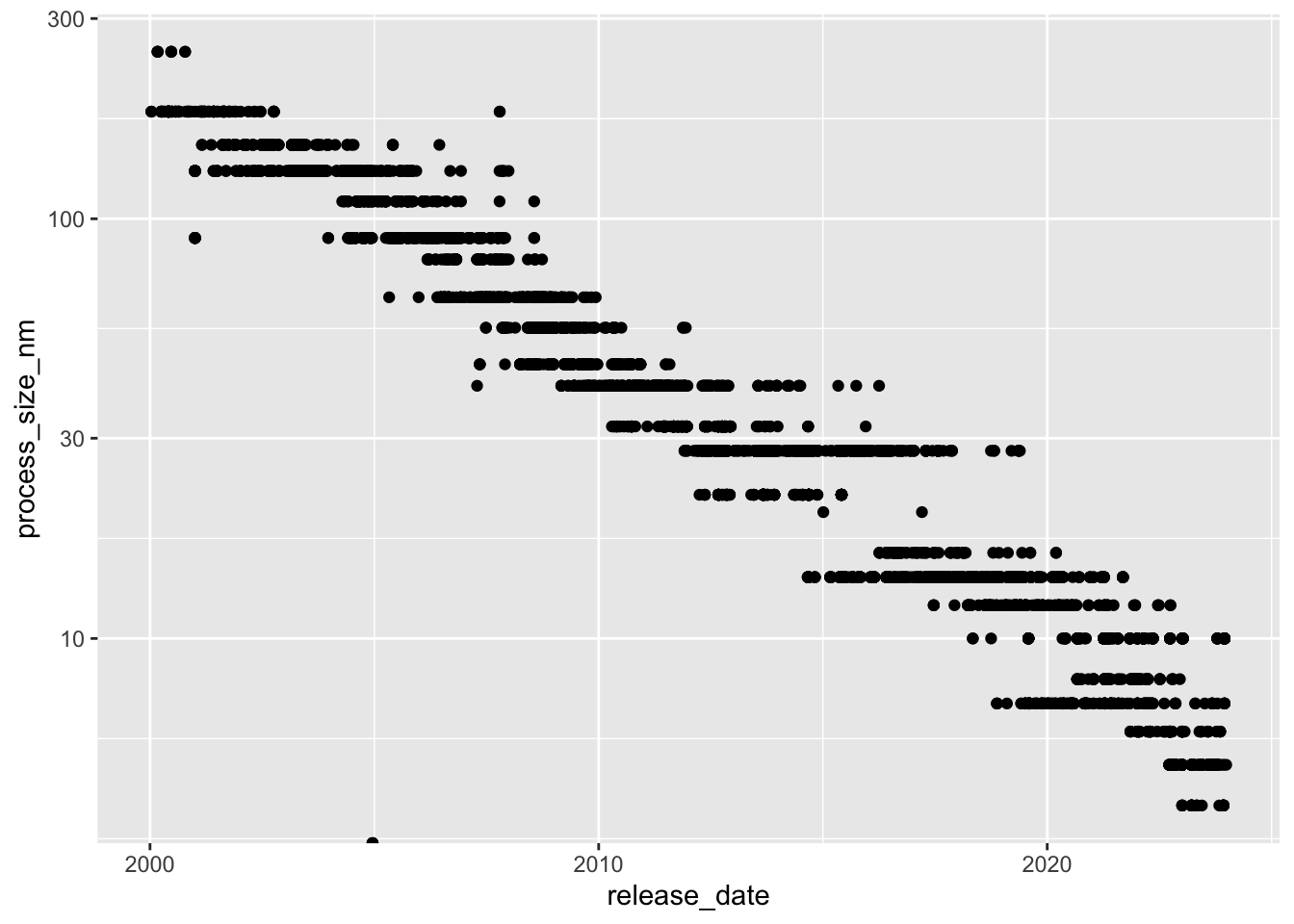
lm(log(fp64_gflops) ~
     log(transistors), data = chips) %>%
  summary()
Call:
lm(formula = log(fp64_gflops) ~ log(transistors), data = chips)

Residuals:
    Min      1Q  Median      3Q     Max
-2.1678 -0.6779 -0.1022  0.4162  3.0476

Coefficients:
                  Estimate Std. Error t value Pr(>|t|)
(Intercept)      -17.76561    0.53241  -33.37   <2e-16 ***
log(transistors)   1.02853    0.02395   42.95   <2e-16 ***
---
Signif. codes:  0 '***' 0.001 '**' 0.01 '*' 0.05 '.' 0.1 ' ' 1

Residual standard error: 0.971 on 1113 degrees of freedom
  (3592 observations deleted due to missingness)
Multiple R-squared:  0.6237,    Adjusted R-squared:  0.6234
F-statistic: 1845 on 1 and 1113 DF, p-value: < 2.2e-16https://www.youtube.com/watch?v=EPusvEQuO2A
https://github.com/rfordatascience/tidytuesday/tree/master/data/2022/2022-08-23
https://github.com/dgrtwo/data-screencasts/blob/master/2022_08_23_chips.Rmd